Fishery Population Status II: The Big Sort Continues

The 2012 South Fork Boise River fishery population sampling by Idaho Fish and Game shows a continuing population size structure that has lots of small fish and large fish making up the raw sample, but few middle sized fish.  And the numbers of medium sized fish are too small to explain the numbers of the larger fish.  Below is the graph showing the 2012 population distribution by size in 2012 compared with 2009 and 2006:
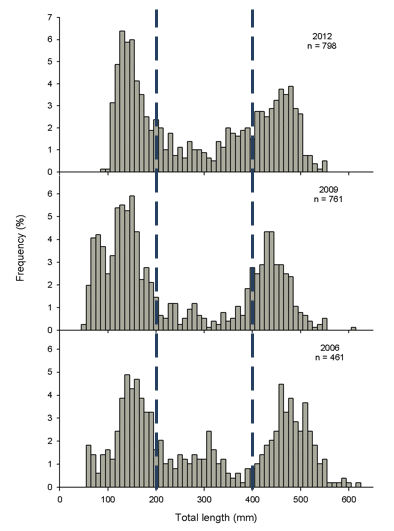
Fish between 200 and 400 millimeters  – roughly eight to sixteen inches in length, are too few to account for the percentage of the population in the 450+ mm size classes.  This seemed especially a problem with the 2006 and 2009 samples as illustrated in the chart.  The 2012 data shows an improvement in the larger end of that size gap.

If you are interested in seeing historic charts back to 1997 you can check out this past blog post.

The question remains:  where are the middle-sized fish that fill the gap so there are the larger fish that we catch?  Some indications are the middle-sized fish are probably rearing in the canyon section of the South Fork as seen in this comparison graph:
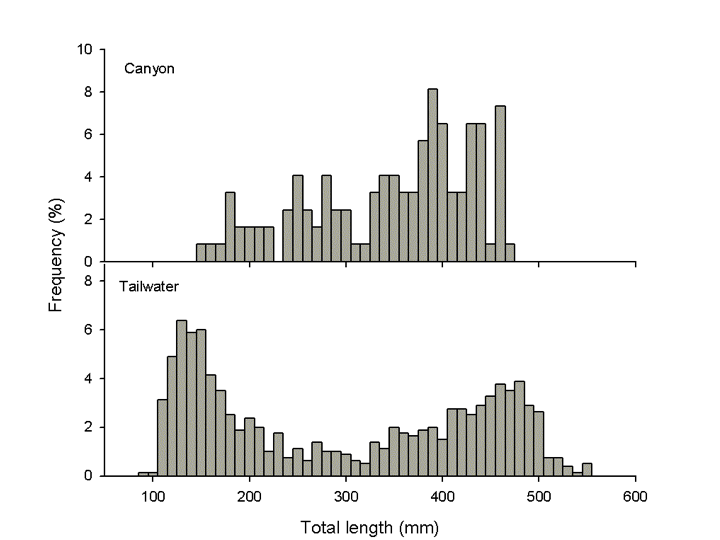
Then they move up and fill the habitat in the reach between Anderson Dam and Danskin Bridge.  It’s not a perfect fit, but the size distribution does help explain some of the gap.

The idea for the title of this post comes from the book The Big Sort published in 2009 and presenting demographic information about how how “Americans have been sorting themselves into extremely homogeneous communities-not just by region and state, but by city and town. Over the past three decades, we have been choosing the neighborhoods, news shows, and places of worship that most closely reflect our individual values.”  OK, so it’s not a perfect fit, but the age/size segregation is an important consideration in helping understand why the South Fork Boise River fishery exhibits an unconventional size class distribution.


Comments

2 responses to “Fishery Population Status II: The Big Sort Continues”

  1. Dan Plantz Avatar
    Dan Plantz

    Is this study always in september? If so, there’s certainly some migration pattern effecting your numbers. I hiked down into a secluded part of the canyon stretch in July 2012, and (once the sun went down), there were 12-14 inch fish coming out of the rocks and litteraly stacked nose to tail all along the edge; it was ridiculous. However, your counts suggest there are few small fish in the canyon stretch. I would agree in september. i went back about september 12, fished the same spot, and there were VERY FEW fish at all. Your numbers of small fish in the tailwater stretch suggest they all moved upstream (i unfortunately did not have the time or energy to fish upstream after killing myself climbing in and out of the canyon). Who knows why exactly, but I would suggest attempting counts at multiple times of year, to account for migration patterns.

  2. Chris Doyle Avatar
    Chris Doyle

    If the n-461, n-761, and n-798 for sample years 2006, 2009, and 2012 respectively in the charts above indicate the comparative total numbers of Rainbows for those years sampled, those numbers indicate a percentage increase in the Tailwater section of 65% of total numbers from 2006 to 2009 and a 73% increase from 2006 to 2012. If that is the case, I think the far more important question to be answered here is what environmental factor(s) can be attributed to such an astonishing population increase in the years 2009 and 2012 compared to 2006 as well as the other drought years of 2000 and 2003. If my memory serves me when IF&G and the U.S. Forest Service made a joint presentation of the 2006 population study at the T.U. membership meeting in April 2007, in addition to the puzzling comparatively low numbers of medium size Rainbows sampled, there was understandably even more concern expressed about the cause of the total decline of Rainbows in all year classes in that year as well as that of the other drought years of 2000 and 2003. In addition, there was concern by IF&G and the Forest Service that the discovery that there was limited spawning in the main stem of the S. Fork due to limited gravel recruitment of the appropriate (smaller) sizes of gravel that had been lost due to the Anderson Ranch Dam which stops the gravel recruitment from downstream migration, coupled with the inability of Rainbows from using the tributaries in the main stem section due to the low precipitation in the years 2000 thru 2006 which had made the tributaries unusable could possibly result in continued low populations in the S. Fork for the years to come. Fortunately, most of us are aware that Mother Nature had since blessed Idaho with normal, and even above normal precipitation in some years such as 2011, starting in years 2007 and continuing through 2012. BVFF Conservation Chairman Dick Frencer and I observed excellent flows in at least two of those years in Rock and Pierce creeks during this time frame, and IF&G found substantial numbers of young of the year Rainbows in those tributaries during the same period of time during the Fall months, and the IF&G sampling conducted in September, 2009 determined a very large number of the year class of Rainbows in the main stem river as well. If we can depend on Ma Nature to continue to bless Idaho with adequate precipitation in the years to come, I expect we will have little to concern ourselves with either the lagging year classes of mid size Rainbows or total numbers of fish populations. However, the start of 2013 up thru mid April has shown a return of a bad water year, and the likely unfavorable conditions in Rock and Pierce Creek of insufficient flows resulting in limited or no reproduction in those tributaries as was the case in past low water years. With this in mind, I now respectfully ask IF&G whether it would entertain the proposal offered by Dick Frencer and myself two years ago to allow BVFF, and other interested parties, to offer both the manpower and materials for a pilot gravel implantation project in the main stem S.Fork Boise in an effort to improve spawning success at selected site below Anderson Ranch Dam.

Leave a Reply